Adapted Books

Adapted books have become one of my favorite resources! What exactly is an adapted book? An adapted book is any book that has been modified in any way to enable it to be more easily accessible to students. This means you can adapt a book to add braille, simplify the text, add visual supports or tactile elements. You could even add a tool to make it easier for students to turn pages!

Slide1

So why use adapted books? If you have ever tried doing a shared reading lesson or any read aloud and struggled to get your students engaged, an adapted book might be an excellent way to increase student engagement. My students love read alouds and each of them do an excellent job of being attentive during our story time. But as their teacher, I want more than just attentive listeners; I want my students to demonstrate what they are taking away from the story which is why I love adapted books. Since my students benefit from the use of visual supports, I prefer to use adapted books that offer visual supports or add them to a story myself.  This allows me to assess what my students know while increasing their vocabulary knowledge and increase opportunities for communication!! Who doesn’t love that?!

I’ve actually started to use more and more adapted books as there are so many resources available now. There are some free templates online so you can make your own or you can purchase them, too. I recently started making my own which are available on my Teachers Pay Teachers store to go with our content topics or seasonal theme. I like to add follow up comprehension questions to my books so I have examples of student work to share with families and data samples.

When choosing adapted books for your students, consider what types of supports they need and how they can benefit from the adapted book. What are some IEP goals that can be addressed through an adapted book? Are there any physical limitations to consider or language barriers? A post by Practical AAC has some wonderful links on various types adapted books and creating them. Be sure to head on over and check them out!

Happy reading!

-Rhiannon


Picture Storage

How do you store ALL.OF.THE.PICTURES?? Do you ever feel overwhelmed by the amount of pictures you have to laminate, cut, Velcro and then sort and store? When I first returned to teaching in a self-contained autism classroom, this felt like such a monumental task for me and the paraprofessional working in the classroom.  How were we going to store so many pictures? Well, after some trial and error we were able to come up with a plan and it was good! At least to us it was.

Enter the tall filing cabinet. Yep, that’s right…a file cabinet. And file folders.  Don’t forget the file folders.

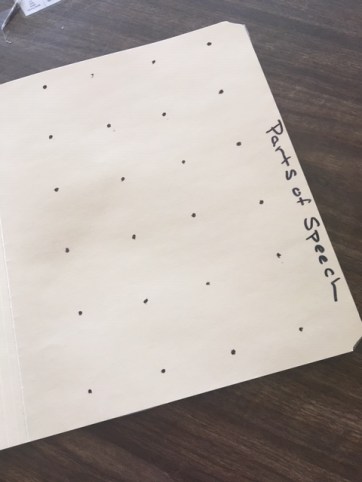
Here was our plan- we were going to make any and every picture we could think of and store the majority of those pictures in file folders. Now this required some extra prepping as we wanted to make our storage system last for years to come. We started by taking plain file folders and measuring out how many 1″, 2″ and 3″ pictures we could fit in a file folder. Once we had a guesstimate, we added marks on the folder for where the Velcro would go

Empty file folder with velcro marks

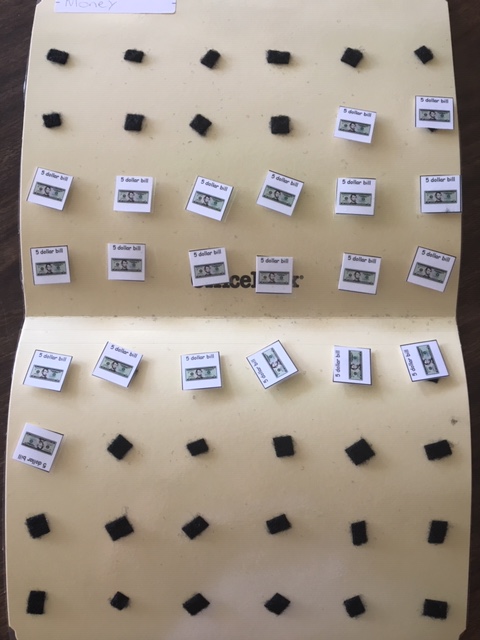
Once the folders were marked we laminated them and began putting Velcro on. After that it was time to put away the pictures! We were so excited for the progress on our picture storage!

IMG_7286

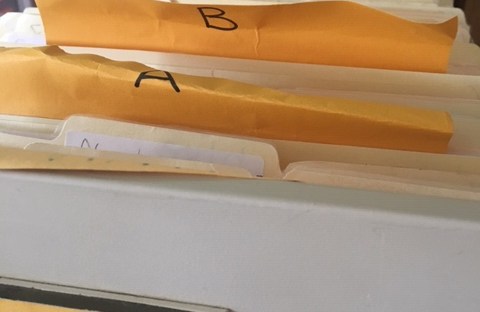
We decided at the time that we were going to sort the pictures into categories as our way of keeping track of specific pictures. That system has since been updated to strictly being alphabetized regardless of the category. This makes it so much easier compared to before when  staff  found themselves needing let’s say a ‘plate’ picture for an upcoming project or because a student was missing his or her ‘plate.’ Was it under Dishes or Plate?? Too much time was spent looking to find exactly what we were looking for. Nobody has that kind of time!

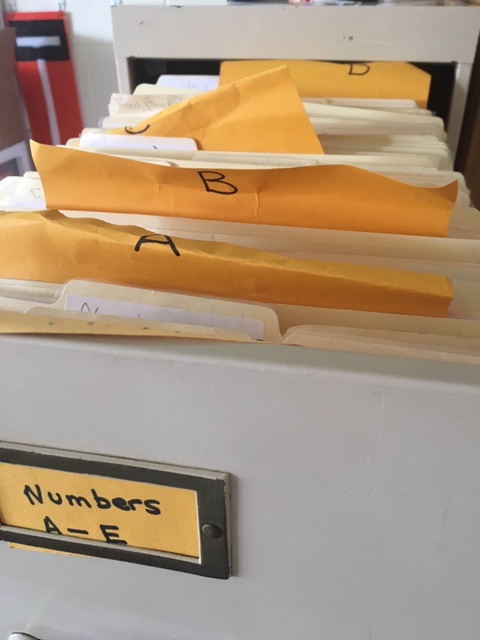
Today this is what our mega storage system looks like. It’s super convenient for EVERYONE. Even some of our students help themselves to pictures from the file cabinet if they need a picture.

IMG_7284

Our tall filing cabinet full of pictures!

Now, what about a quick and easy system for storing pictures? Stay tuned for an update on that soon!

**NOTE** The students in my room begin learning functional communication using PECS (the Picture Exchange Communication System) before transitioning to speech or a speech generating device.